 Skip to content



If you’ve no hot water, the usual culprits are a boiler fault, a tripped switch, low system pressure, a broken thermostat, or an airlock in the pipes. Most of these have a quick check you can do yourself before you pick up the phone.
Start with the simple stuff. Is the boiler firing? Has a fuse tripped? Is the pressure gauge reading right? Nine times out of ten, a no-hot-water call comes down to one of a handful of faults, and a few of them you can sort in five minutes.
Below we walk through each common cause, the safe checks you can do at home, and the point where it stops being a DIY job and becomes a call to a qualified plumber.
Why Do You Suddenly Have No Hot Water?
You suddenly have no hot water usually because the boiler has stopped firing, a switch has tripped, the pressure has dropped too low, or a thermostat or timer has failed. A cold morning after a frost points to a frozen condensate pipe. A gradual loss of heat points to sludge or a failing part.
Work through the likely causes in order of how common they are:
- Boiler not firing from a fault, lockout, or no gas supply.
- Low boiler pressure, often under 1 bar on the gauge.
- A tripped fuse or switched-off spur to the boiler.
- A failed thermostat, timer, or a knocked heating schedule.
- A frozen condensate pipe after cold weather.
- An airlock or a stuck diverter valve in a combi.
If you’ve heat in the radiators but no hot water at the tap, that narrows it down fast. It usually means a diverter valve fault in a combi boiler, which is a job for a technician.
How Do You Check Boiler Pressure and Reset It?
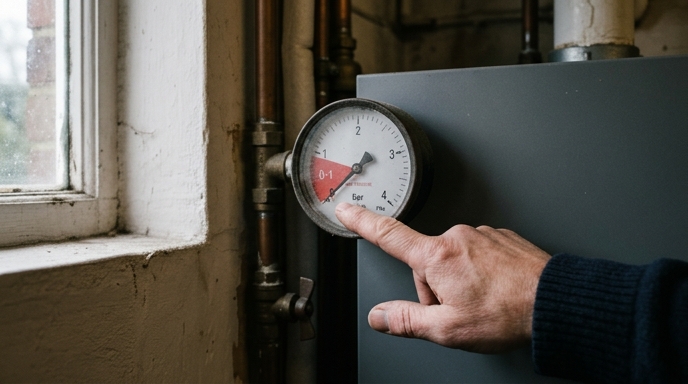
Low boiler pressure is one of the most common reasons for no hot water, and you can often fix it yourself in a few minutes. Look at the pressure gauge on the front of the boiler. It should sit between 1 and 1.5 bar when the system is cold. If the needle is down near zero, the boiler may have locked out to protect itself.
1. Topping Up the Pressure
To bring the pressure back up, use the filling loop, which is the small silver braided hose under the boiler with a valve at each end.
- Turn the heating off and let the boiler cool.
- Open both valves on the filling loop slowly until you hear water flowing.
- Watch the gauge and close the valves once it reaches around 1.2 bar.
- Reset the boiler if it shows a lockout code, then check it fires.
2. When the Pressure Keeps Dropping
If the pressure falls again within days, you’ve a leak somewhere or a failed expansion vessel. Don’t keep topping it up as a permanent fix. A repeated drop means a part needs replacing, and that’s a call to a plumber rather than a DIY repair.
What If the Boiler Isn’t Firing at All?
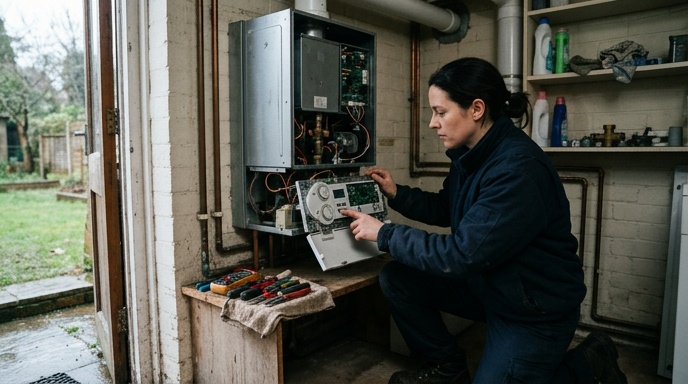
If the boiler isn’t firing at all, first rule out power and gas before assuming it’s broken. A dead display usually means no power, while a fault code on the screen means the boiler has detected a problem and locked out. Both are worth ten minutes of checks before you call anyone.
Run through these in order:
- Check the fused spur or switch beside the boiler is on.
- Check the fuse board for a tripped breaker and reset it once.
- Make sure other gas appliances work, so you know the supply is on.
- Note any fault code on the display and press reset once, not repeatedly.
If you smell gas at any point, don’t touch switches. Open windows, turn off the supply at the meter, get everyone out, and ring the emergency gas line. Gas work must be done by an RGI-registered installer by law in Ireland, so anything beyond a single reset needs a professional. You can read the official guidance on gas safety and registration requirements for more detail on why registration matters.
Could a Frozen Condensate Pipe Be the Problem?
A frozen condensate pipe is a very common cause of no hot water after a cold snap, and it’s one you can often thaw yourself. Modern condensing boilers drain acidic water through a plastic pipe, usually running outside to a drain. In a hard frost, that water freezes and blocks the pipe, so the boiler shuts down and shows a fault code.
Here’s how to spot and thaw it safely:
- Look for a white or grey plastic pipe leaving the wall near the boiler.
- A gurgling sound from the boiler often points to a frozen line.
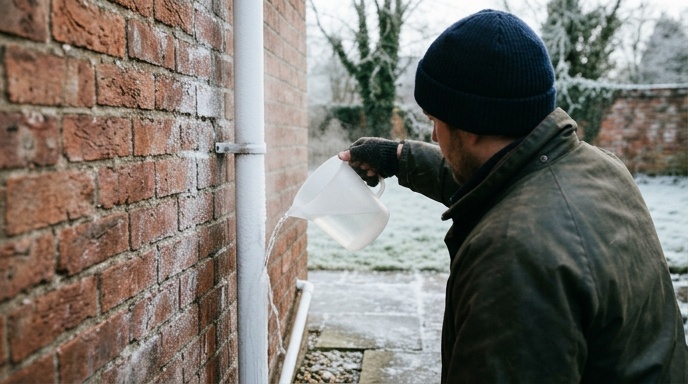
- Pour warm, not boiling, water along the exposed pipe, especially at bends.
- A hot water bottle or a jug of warm water works well on the blockage.
Once thawed, reset the boiler and it should fire again. To stop it happening next winter, ask a plumber about insulating or re-routing the pipe. During a cold spell, a proper boiler service also picks up small faults before they leave you cold on the worst morning of the year.
Why Is There Heat but No Hot Water in a Combi?
Heat in the radiators but no hot water at the taps usually means a faulty diverter valve in a combi boiler. The diverter valve switches the boiler between heating your radiators and heating your tap water. When it sticks or wears out, it stays on the heating side and never diverts to hot water.
This isn’t a DIY fix. The valve sits inside the boiler and replacing it needs an RGI technician who can strip the unit down safely.
| Symptom | Likely Cause | DIY or Plumber |
|---|---|---|
| No heat and no hot water | Pressure, power, or lockout | DIY checks first |
| Heat but no hot water | Diverter valve fault | Plumber |
| Hot water but no heat | Pump, valve, or sludge | Plumber |
| Lukewarm water only | Thermostat or scale | Plumber |
If your water is only lukewarm rather than gone entirely, the cause is often a thermostat set too low or a build-up of limescale and sludge slowing the heat exchange. A power flush can restore performance on a sludged-up system, though a technician should confirm the diagnosis first.
When Should You Call an Emergency Plumber?
Call an emergency plumber when you’ve done the safe checks and still have no hot water, when the pressure keeps dropping, when you smell gas, or when a leak is getting worse. No hot water in winter with young children or elderly relatives in the house is reason enough to get someone out fast rather than wait.
These situations shouldn’t wait until morning:
- A gas smell, or a boiler locking out repeatedly after resets.
- Water leaking from the boiler, a cylinder, or pipework.
- No heat and no hot water during a cold snap.
- A pressure gauge that won’t hold after topping up.
For genuine breakdowns, a 24-hour callout gets a qualified plumber to your door, often within the hour. Reviews for the team here regularly note arrivals inside 40 to 45 minutes on emergency jobs, which matters most when the heating’s gone in the middle of a January freeze.
How Do You Stop It Happening Again?
The best way to avoid a no-hot-water morning is an annual boiler service and a bit of simple winter prep. A yearly service checks the pressure, flue gases, and key parts, catching worn components before they fail. Insulating exposed pipes stops frost knocking your boiler out.
A few habits keep the system reliable:
- Book a gas boiler service once a year, ideally in autumn before the cold.
- Lag any exposed pipes and the condensate line outside.
- Bleed radiators if they’re cold at the top or slow to heat.
- Keep an eye on the pressure gauge through the winter months.
Landlords have an added duty here, since gas safety inspections and up-to-date certificates are part of keeping a rental compliant and tenants warm.
Sorting a No Hot Water Problem for Good
Most no-hot-water faults come down to pressure, power, a frozen pipe, or a worn part, and a few of those you can put right yourself in minutes. When the safe checks don’t fix it, or there’s any sign of gas or a leak, that’s the point to bring in a professional rather than push your luck.
If you’re stuck without hot water and the DIY checks haven’t worked, call the 24-hour line on (01) 963 6090 or request a quote for a fast, RGI-registered fix.