Skip to content


An oil boiler not working usually comes down to one of a few things: no oil in the tank, a lockout on the control box, a tripped electrical supply, or a dirty nozzle and filter starving the burner. Most of these are quick to spot once you know where to look.
Some you can sort yourself in a few minutes. Others, like a faulty pump or a fuel line fault, need a technician with the right kit.
Below we walk through the most common causes in the order worth checking, the safe fixes you can try at home, and the point where you should stop and call for help.
What Are the Most Common Reasons an Oil Boiler Stops Working?
The most common reasons an oil boiler stops working are an empty or low oil tank, a burner lockout, a loss of power, a blocked nozzle or filter, and sludge or air in the system. Fuel and lockout faults account for the bulk of winter breakdown callouts.
Here are the usual suspects, roughly in order of how often they’re the real cause:
- No oil or low oil in the tank, even when the gauge looks fine.
- Burner lockout shown by a red reset light on the control box.
- Power loss from a tripped fuse, timer fault or dead thermostat batteries.
- A clogged oil filter or nozzle choking the fuel supply.
- Air in the fuel line after the tank has run dry.
- A seized pump, faulty photocell or frozen condensate pipe in cold spells.
Work through them from the simplest first. Nine times out of ten the fault is fuel, power or a lockout before anything mechanical.
How Do You Fix an Oil Boiler Lockout?
Fix an oil boiler lockout by pressing the reset button on the burner control box once and waiting for it to fire. A lockout is a safety feature that shuts the burner down when it fails to ignite, so the reset tells it to try again. Press it only once.
If it fires and stays running, the lockout was a one-off and you’re grand. If it locks out again within minutes, there’s an underlying fault and repeated resetting can flood the chamber with unburnt oil.
Follow this safely:
- Find the reset button, usually a small red or amber button on the burner.
- Press it once and give the burner 30 seconds to ignite.
- If it starts and runs, you’re done.
- If it locks out again, stop. Do not keep pressing it.
- Check for an obvious cause like no oil before calling a technician.
Repeated lockouts point to a dirty nozzle, a photocell fault, or no fuel reaching the burner. That’s a job for a service engineer, not another press of the button.
Could You Be Out of Oil Even If the Gauge Reads Full?
Yes, oil tank gauges fail regularly and a stuck float or sight gauge can read full when the tank is nearly empty. Running out of oil is one of the most common reasons a boiler stops firing in winter, so always check the tank physically before assuming a mechanical fault.
Don’t trust the dial alone. Here’s how to check properly:
- Open the tank and dip it with a clean stick if it’s a sight gauge type.
- Tap a float gauge gently, as the float can stick at the full mark.
- Listen for a gurgle when the burner tries to fire, a sign of air drawn in by low oil.
- Check for a kerosene smell near the tank, which can mean a split line or leak.
If you’ve run the tank dry, topping up isn’t the end of it. Air gets drawn into the fuel line and the system needs bleeding before it’ll fire cleanly again.
What to Do After Running Out of Oil
After refilling, the fuel line usually needs bleeding to clear trapped air before the burner will stay lit. Many modern burners self-prime, but older systems don’t. Give fresh oil 10 to 15 minutes to settle, then press the reset once. If it won’t hold, the line needs bleeding at the pump, which is best done by a technician.

Why Does Your Oil Boiler Have No Power or Won’t Turn On?
An oil boiler with no power usually has a tripped fuse, a fault at the fused spur, flat thermostat batteries, or a programmer stuck on an off cycle. These electrical faults stop the boiler before it even attempts to fire, so there’s often no noise, no light and no heat at all.
Run through the basics before suspecting the boiler itself:
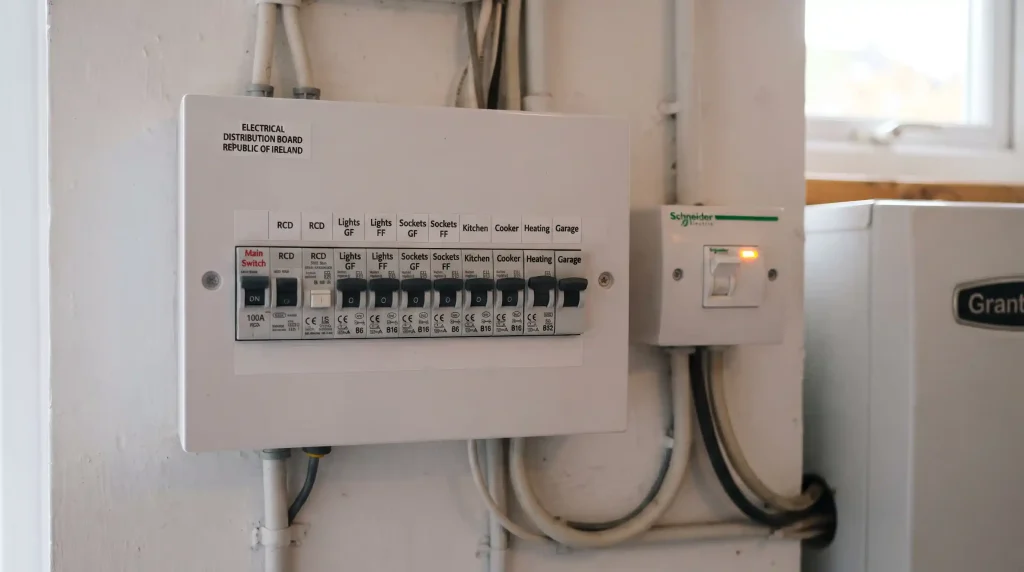
- Check the fuse board for a tripped switch and reset it once.
- Confirm the fused spur or isolation switch beside the boiler is on.
- Replace the thermostat batteries if the display is blank or faint.
- Make sure the programmer or timer is calling for heat, not sitting in an off period.
- Check the room thermostat is set above the current room temperature.
A timer that reverts to factory settings after a power cut is a common culprit people miss. If power and settings all check out and there’s still nothing, the fault is inside the boiler and needs a look.
Why Is There No Heat but Hot Water Still Works?
If you have hot water but no heat, the boiler is firing fine and the fault sits in the heating circuit, usually a stuck diverter valve, a seized circulation pump, sludge in the radiators or an airlock. The burner working for hot water rules out fuel and ignition problems straight away.
The likely causes, in order worth checking:
- A failed diverter valve stuck on the hot water setting.
- A seized or airlocked circulation pump that won’t move water to the rads.
- Sludge build-up blocking flow, common in older systems.
- Trapped air leaving radiators cold at the top.
Bleeding your radiators clears trapped air and is worth trying first. If some rads stay stone cold after bleeding, you’re likely looking at sludge, and a power flush to restore circulation may be needed. A diverter valve or pump replacement is a technician job, not a DIY fix.

When Should You Call a Technician Instead of Fixing It Yourself?
Call a technician when the boiler locks out repeatedly, there’s a smell of oil, water leaking from the unit, the burner won’t fire after a reset, or any fault involving the fuel pump, photocell or electrics. These need proper diagnosis and parts, and poking at them can make things worse or unsafe.
Stick to the safe checks and leave the rest. Call for help if you notice any of the following:
- A strong oil or burning smell, or visible leaking fuel.
- Repeated lockouts after a single reset.
- Black smoke or soot around the flue or boiler casing.
- Water pooling under the unit or dripping pipework.
- No fire after you’ve confirmed oil, power and settings.
A proper oil boiler service and repair clears nozzle, filter and combustion faults in one visit, and a technician will spot wear before it leaves you cold.
If your heating fails overnight in a cold snap, you don’t want to be waiting, so a fast 24-hour callout matters. For an older or unreliable unit, it’s also worth weighing a repair against a full boiler replacement.
Not sure which way to go? Call the 24-hour line on (01) 963 6090 and we’ll get your heat back on.