 Skip to content



Low water pressure usually comes down to one of a few things. A partially closed stopcock, a blocked or clogged aerator, a faulty pressure-reducing valve, airlocks in the system, or a leak somewhere in your pipework. Sometimes the problem sits with the mains supply itself, well before it reaches your home.
The good news is that plenty of low water pressure issues have simple fixes you can try yourself before ringing anyone. A few are quick five-minute jobs at the tap or the stopcock.
Others, like a hidden leak or a failing valve, need a qualified plumber. This guide walks you through why it happens, the checks you can do at home, and the point where it’s worth getting a professional in.
What Causes Low Water Pressure in a House?
Low water pressure in a house is caused by a restriction or loss somewhere between the mains and your tap. The most common culprits are a partly closed valve, a blocked fitting, a failing pressure valve, trapped air, or a leak. Pinning down which one tells you whether it’s a DIY fix or a plumber’s job.
Here are the usual suspects behind a weak flow:
- Partially closed stopcock or isolation valve throttling the supply.
- Blocked tap aerators or a clogged showerhead from limescale build-up.
- A faulty pressure-reducing valve that has drifted or failed.
- Airlocks in the hot water system after work or a drain-down.
- Corroded or scaled-up old pipework narrowing the bore.
- A leak on the supply, often hidden under floors or in walls.
If the pressure dropped suddenly across the whole house, suspect the mains, a valve, or a leak. If it’s been slowly fading at one tap, limescale or a blocked aerator is the likely story.
Is Low Pressure Affecting One Tap or the Whole House?
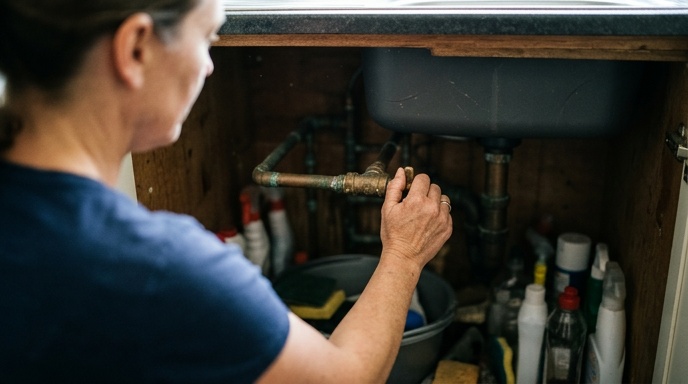
Working out whether the problem is one tap or the whole house is the fastest way to narrow the cause. One weak tap points to a local blockage or valve at that fitting. Weak pressure everywhere points to the mains, the main stopcock, or a system-wide issue like a pressure valve or a leak.
Low Pressure at a Single Tap or Shower
A single weak tap or shower is nearly always a blockage or a part-closed isolation valve at that outlet. Limescale clogs the aerator on the tap nose or the holes in a showerhead. Check the quick-fix section below before assuming anything major.
Low Pressure Across the Whole House
Weak pressure everywhere usually means the problem is upstream. Start at the main stopcock to make sure it’s fully open. If that’s fine, the issue could be the mains supply, a failed pressure-reducing valve, or a leak on your incoming pipe drawing pressure away.
How to Fix Low Water Pressure Yourself
You can fix many low water pressure problems yourself with a few simple checks. Start with the valves, clean the aerators and showerhead, and look for obvious leaks. These cost nothing but time and clear the most common causes before you pay for a callout.
Work through these in order:
- Check the main stopcock is turned fully anticlockwise and open. It’s usually under the kitchen sink or near the front of the house.
- Check any isolation valves under the affected sink or behind the appliance are fully open.
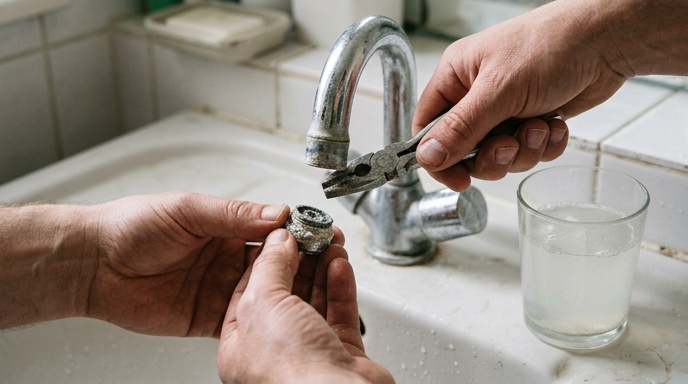
- Unscrew the tap aerator (the little mesh tip) and soak it in white vinegar to clear limescale, then refit it.
- Soak a clogged showerhead in vinegar overnight, or replace it if it’s badly scaled.
- Look under sinks, around the boiler, and along visible pipes for damp patches or drips.
If none of that lifts the pressure, the fault is likely deeper in the system. That’s the point to stop and call a plumber rather than start pulling pipework apart.
Why Is My Hot Water Pressure Low but Cold Is Fine?
Low hot water pressure with normal cold usually points to the hot side of the system, not the mains. The common causes are a scaled-up hot water cylinder, a blocked hot outlet, an airlock, or a boiler or combi fault restricting hot flow. Because the cold feed is unaffected, you can rule out the main supply straight away.
Typical reasons the hot side lags behind:
- Limescale build-up inside a hot water cylinder or heat exchanger.
- An airlock trapped in the hot pipework after a repair or drain-down.
- A partly closed valve on the hot feed only.
- A combi boiler struggling to deliver hot water at full flow.
Airlocks can sometimes be cleared by connecting the hot and cold taps briefly, but anything involving the cylinder or boiler is best left to a professional. If you’ve an older system, sludge may be part of the picture, which is where a boiler service and system check earns its keep.
When Does Low Water Pressure Mean a Leak or Mains Problem?
Low water pressure signals a leak or mains problem when the drop is sudden, affects the whole house, and you’ve already ruled out valves and blockages. A hidden leak bleeds pressure away and often shows up as damp patches, a running meter with all taps off, or an unexplained spike in your water charges.
Watch for these warning signs:
- Pressure drops suddenly rather than fading over weeks.
- Damp patches, mould, or warm spots on floors that hint at a hidden pipe leak.
- The whole street has low pressure, which points to an Irish Water mains issue.
- Water pooling near the boundary or stopcock with no clear source.
If the whole area is affected, check for updates and reported outages through Uisce Éireann supply information before assuming the fault is yours.
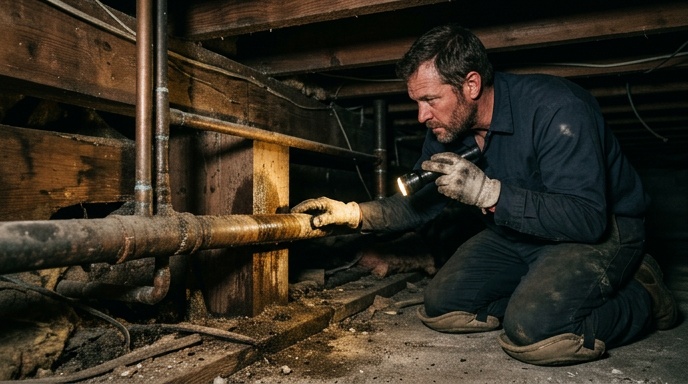
For anything inside your boundary, a plumber can trace the leak with the right kit and sort the repair before it does real damage. For a leak detection and repair job, the sooner it’s found, the cheaper it stays.
How to Prevent Low Water Pressure Problems
You prevent most low water pressure problems with routine maintenance. Descaling taps and showerheads, servicing your boiler yearly, keeping an eye on the pressure gauge, and dealing with small leaks early all stop minor issues becoming a full-system headache. Prevention is far cheaper than an emergency callout on a cold winter morning.
A few habits that keep your flow strong:
- Descale aerators and showerheads a couple of times a year, especially in hard-water areas.
- Book an annual boiler and heating service to catch sludge and scale early.
- Check your boiler’s pressure gauge sits in the normal range, usually around 1 to 1.5 bar cold.
- Fix drips and small leaks quickly before they worsen.
- In winter, keep pipes lagged to avoid freezing and the pressure loss that follows.
Hard water is a genuine issue in parts of Dublin, so scale builds faster than you’d think. A yearly service keeps the system clean and often spots a pressure problem before you even notice it at the tap.
Low water pressure is usually fixable, and most of the time you can solve it yourself with a few simple checks. When the valves are open, the aerators are clean, and the flow still won’t come back, that’s the signal to bring in someone who can trace the real cause.
If your water pressure has dropped and the quick fixes haven’t worked, get a quote from our team or ring the 24-hour line and we’ll get it sorted.